


Who Should You Ask? Choosing Participants for UX Research
What you need to know about your interface's target audience, and why not everyone should take part in your research.
To design or improve an interface, designers form hypotheses, work to understand user needs, and constantly observe and analyze. Some problems are right on the surface; others can only be uncovered through surveys, in-depth interviews and usability testing.
Research findings help you understand what problems users face with a product and how to improve it:
- what's wrong with the website navigation
- why a user adds a product to the cart but never buys it
- whether users notice the newsletter signup offer
That way, designers solve people's real problems, not imaginary ones.
UX research can be useless if you work with the wrong audience. In this article we look at which target audience to work with so that the results are reliable and valuable.
Companies often skip research, even when they have the time and money for it. Or, when the budget is being agreed, the client rolls their eyes and says, "It's crazy to spend that much money, just design it and be done." Then the product launches, nobody uses it, and even more money goes into a new design or a redesign.
Define your research goals
This is the first criterion for screening your audience. Research starts with a global goal, for example: "We want to increase the number of app users by 20%." The goal is broken down into smaller tasks: what exactly you want to learn along the way and what could help grow the number of users.
The tasks are set according to the product's stage of development and the purpose of the research.
| At an early stage | In a live product | When finishing new features or expanding the product |
|---|---|---|
| Understand what the user wants | Understand how people use the product, what they like and what they don't | Compare the product with competitors |
| Understand the scope of the problem and its impact on users | Make the product more convenient | Understand how people react to an updated design, for example which details or elements they notice first |
| Test ideas and hypotheses | Find similarities in behavior, habits and interests across the target audience |
Once the task is defined, you can work out the audience criteria for the research.
Large-scale UX research is expensive and can end without results. To save money and time, run a short study focused on the features that matter most to users and the business.
Rely on user experience
This is the most important criterion for choosing your audience. It helps you build on the user's previous interaction with the interface: how they behaved when solving similar problems, and the issues they hit with the target action, such as placing an order, visiting a specific page, signing up for a newsletter or filling in a form.
By this criterion, participants fall into three groups: experienced users, users with similar experience and inexperienced users.
Experienced users are people who know the product well. "Know well" sounds vague, so it's better to be specific with criteria such as:
- how long they've used the product
- how often they use it
- how long each interaction lasts
- how many features they've used
- the context and reasons for using the product
Experienced users have known your product for a long time, so one way or another they've run into various problems. They can tell you why they chose it and when they use it.
Keep in mind that experienced users eventually stop noticing obvious problems and find workarounds for the inconvenience. Because of this, research results can be skewed
It's very important not to confuse experienced users with experts. Experts often build products themselves or work in the same or a related field: designers, editors, developers, marketers. It's hard for them to set aside their professional experience and look at the interface through the eyes of an ordinary user.
Users with similar experience - these are also experienced users, but they use a competitor's product.
They help you look at the product with fresh eyes, and they know how to solve their problems in a different interface. Before the research, these people haven't used your product, so they may find more problems than experienced users.
Inexperienced users - people who have never tried your product or anything like it.
Inexperienced users are usually invited to take part in research to see how they interact with the product for the first time and cope with scenarios in an unfamiliar interface
Random people often end up in this group. Don't invite someone just because they've never used your product or something similar. First, check whether the product interests them. If it doesn't, they'll complete the tasks reluctantly and without the necessary understanding, and research like that is of little use.
In reality, there are quite a lot of random users, especially when launching a new product. There's nothing wrong with that. But the more user interviews you run, the more specific and detailed your audience targeting becomes. Put the answers from users who don't fit into a folder and keep them. They'll come in handy in a new round of product development, an expansion or the launch of a new feature.
Consider devices, profession and product loyalty
Mobile devices and operating systems. User habits on Windows and macOS, Android and iOS differ. And the problems with an app can differ across platforms too. For example, the same online store will have different audiences: one person buys through the desktop version of the website, another through the app, and a third doesn't use the app but buys through the mobile version of the website.
Expertise. When users can't be recruited, researchers turn to the professional community. But if you show your interface to a developer, they'll evaluate the wrong things: they'll focus on loading speed and how accurately the mockup was built instead of text readability, how convenient the filters are and where the buttons are placed. That skews the research results, and the team wastes time and money polishing things that usually don't matter to users.
Product loyalty. It's easy to ask colleagues, parents and friends. You don't need to pay them, they understand the researchers' pain and are happy to help. But colleagues may be too soft or too picky, because they've dealt with similar problems when developing their own products.
Sometimes we run research inside the company, with colleagues who aren't involved in product development at all. Managers, designers and developers are too biased an audience. Each of them will judge by what they're used to working with. Sales, on the other hand, are close to our audience and can feel like ordinary users.
Sometimes experienced users become too loyal to the company behind the product or to the product itself. They've used it for a long time, they're used to its shortcomings and don't see alternatives. With users like these you need to be more careful: even in the worst case, they may say everything is fine.
Don't focus only on gender, age, location and other demographics
A common mistake is to start selecting respondents based on the audience's socio-demographic characteristics: gender, age, marital status, education and location. These may not be enough to get good results. A participant may match on age and location but use the product for different purposes. For example, you want to understand how people buy and sell cars on your website, but your research participants are more interested in reading your news.
Socio-demographic characteristics help you take the audience's skills and traits into account from different angles. But the outcome will be shaped by actual behavior, the desire to use the product, and the likelihood and frequency of using it.
Create personas based on all the criteria
A persona is a description of a typical user of the product, with specific behaviors and attitudes toward it.
- Personas help you refine interface copy and the logic behind new scenarios and redesigns
- They serve as templates when recruiting users, which makes life easier for the team in future research
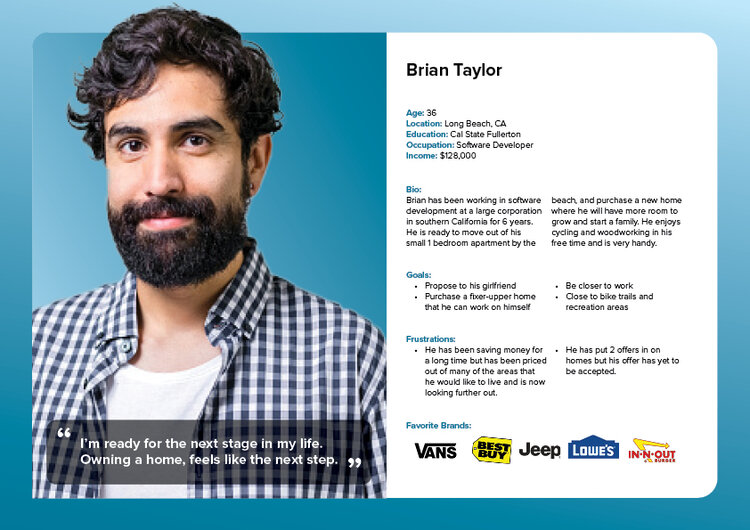
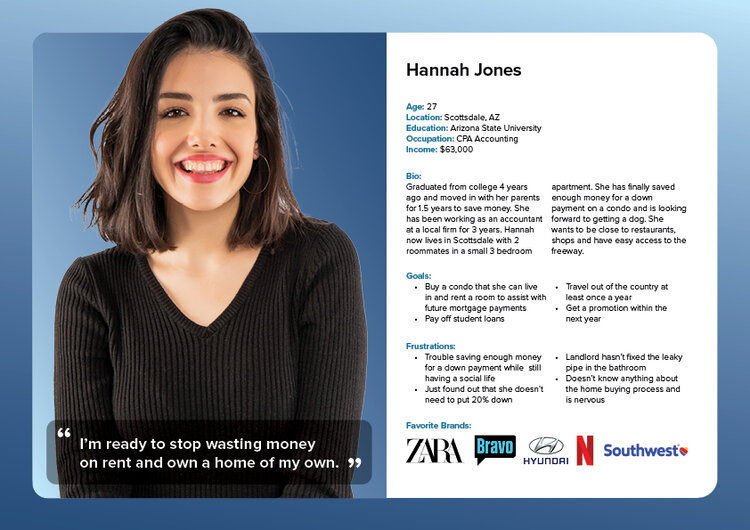
Don't rely on Google Analytics data alone, or you'll end up with the wrong audience profile. Connect with real people to better understand their goals and needs.
Examples of tasks and audiences for UX research
| Task | Users who shouldn't take part | Suitable users |
|---|---|---|
| Find out what problems occur in an online store at checkout: users add a product to the cart but don't buy | Experienced users. They've already completed the target action, so their opinion won't be objective | Users with similar experience: people who have ordered clothes from other online stores but haven't used your product |
| Assess the usability of a new app for transferring money | Colleagues, friends or parents: they'll try to say something nice or, on the contrary, be pickier than ordinary users | People who use mobile banking all the time: they have experience transferring money |
| Simplify booking doctor's appointments online in the clinic's patient portal | Inexperienced users. If someone is used to calling the clinic, they'll have more trouble booking an appointment online for the first time than a regular user | Users who have already booked an appointment 2-3 times at your clinic or another one |
Things to remember!
- First, define a global goal and specific tasks that will get you there in small, precise steps
- Experienced users and beginners help you identify different problems in the interface
- To avoid skewing the research results, consider which platform the user is on, their profession and their loyalty to the product
- Leave socio-demographic characteristics for the later stages of research, as they have little impact
- Describe the audience with personas, then talk to real people to refine or adjust them
Disclaimer: blog content is for general information and learning only and is accurate as of its publication date. It is not professional, legal, financial or business advice, nor a recommendation or call to take any action. Any use of this information is at the reader's own risk, and we accept no liability for any resulting loss. Links to external websites and tools are provided for convenience only. We recommend consulting a qualified professional before making decisions.