


The Marketing Mix and the 4Ps: A Practical Guide
Marketing is full of theories, frameworks and acronyms. Most of them are forgotten after a season, but a handful of core ideas sit underneath every product or service that has ever been promoted. The marketing mix is one of them.
The idea is simple: success in a market does not depend on a great ad alone, or on a great product alone. It depends on whether all of your marketing decisions – what you sell, at what price, where people can buy it and how you talk about it – pull in the same direction instead of working against each other.
In this guide we cover:
- what the marketing mix is and why even a small business needs one;
- what the classic 4P model is made of and how it looks in a digital business;
- which other models exist: 5P, 7P, 4C and SIVA;
- how to build a marketing mix in six steps;
- which principles keep the mix effective and which mistakes to avoid.
What the marketing mix is and why you need it
The marketing mix is a framework that describes every element a business controls in order to bring a product or service to its customers. It is an integral part of your marketing strategy: the strategy decides where the business is heading, and the mix turns that direction into concrete, day-to-day decisions.
Marketing is a basic function of any business. Its job is to move a product or service from the company that makes or delivers it to the customer, whether that customer is a consumer or another business. That is why every marketing decision touches one of the parts of this journey: the product itself, its price, the way people buy it and the information they receive about it.
Why you have to think about all the elements together
The marketing mix exists to force a joined-up view. Instead of handling each topic in isolation – for example, launching a campaign without checking whether the website is ready to receive the leads – you look at every element that affects success and make sure they support one another. When the elements are aligned, every euro you spend on advertising works harder.
Where the idea came from
The term "marketing mix" emerged in American academia in the late 1940s and was popularised by Harvard professor Neil Borden. The classic and best-known model, the 4Ps, was set out by professor E. Jerome McCarthy in his 1960 textbook. More than sixty years later it is still taught in every marketing course, because it gives business owners, marketers, designers and developers a shared vocabulary.
The 4P model: the four elements of the marketing mix
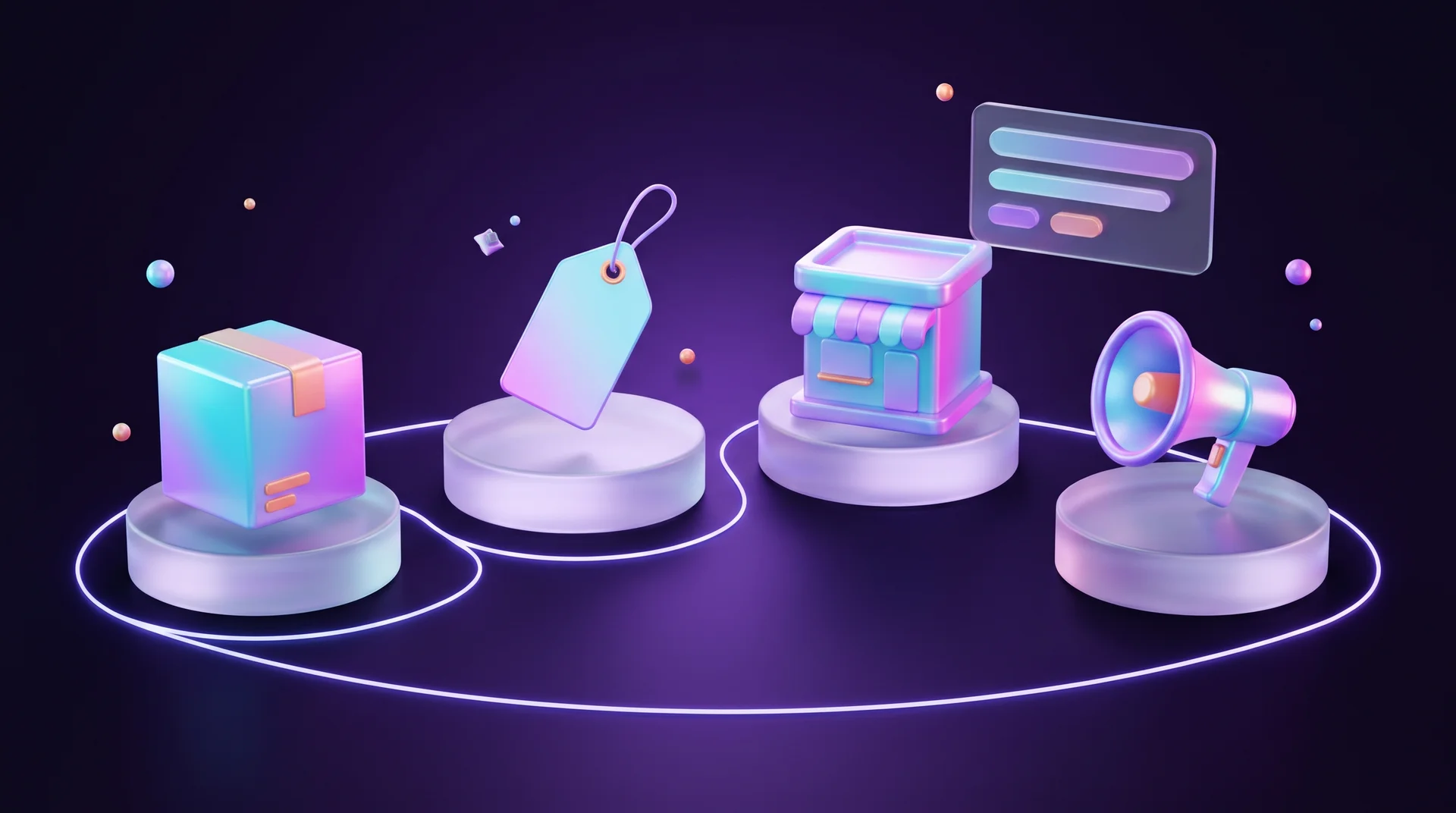
The 4P model has four elements, and each of them starts with the letter P.
Product
Everything related to the product or service itself: development, design, quality, packaging, brand name, after-sales service, warranty, range of models and personalisation. In a service business, the product is also the way you work: how fast you respond, what the client actually receives at the end and in what form.
The key questions here: what problem does the product solve? How is it different from the competition? What does the customer really get, beyond the description in the catalogue?
Price
Your pricing policy: pricing strategy, pricing method, discounts and incentives, payment terms and delivery terms. It also includes very practical choices, such as whether to offer instalments, which payment methods to accept (cards, Apple Pay and Google Pay, bank transfer) or whether to sell a monthly subscription instead of a one-off fee.
Remember that price is not just a number. It is a message. A price that is too low for a premium service raises suspicion, and a high price without a clear explanation of value drives customers away. Local rules matter as well: across the EU, prices shown to consumers generally need to include VAT, which affects how you design the pricing page on your website. If you are unsure about the rules in your market, check with a local adviser – this is not legal advice.
Place
Originally this meant the physical place where a product is sold. Today we talk about distribution: every route by which the product travels from the business to the customer. That includes choosing sales channels, retailers and agents, the sales team, shipping and storage terms, logistics and inventory management.
In a digital business, Place is first and foremost the website: an online store, a landing page, a booking form, a WhatsApp button. But it is also a marketplace, your Google Business Profile, a physical shop or sales through partners.
Promotion
Your communication policy: everything designed to tell customers about the product, build demand and encourage a purchase. This covers advertising, public relations, sales promotions, personal selling, branding, direct marketing, sponsorship and content. Put simply, it is every tool the business uses to talk to its target audience.
For promotion to work, you need to know who you are talking to. If you have not defined your ideal customer yet, start with our guide to defining your target audience.
The principle: the elements only work together
The whole point of the marketing mix is that you work on all the elements at the same time. A great product is not enough. You also have to justify its price, plan how customers will hear about it and make sure it is easy to buy. An excellent product with a website that will not load on a phone will lose to an average product with a smooth buying experience.
The 4Ps in a digital world: how the elements look in 2026
The 4P model was born in the era of television, newspapers and high-street shops. Its principles have not changed, but the tools have changed enormously. Here is how the four elements look in a business that sells online.
The product includes the digital experience
Customers meet your product before they buy it: in photos, in the description, in reviews and in how quickly your website responds. That makes design, accessibility and usability part of the product. A slow or confusing website lowers the perceived value of an excellent service. This is where UX/UI work comes in: it turns the promise of the product into an experience people can actually feel.
Pricing online: transparency and comparison
Online, customers compare prices in a few clicks. Decide in advance whether you publish prices on your website, price ranges or "from" prices, and explain what is included in each package. Options such as three-tier packages, a free trial or instalments make the decision easier, but they have to match your brand positioning.
Place: your website, messaging apps and marketplaces
For most small businesses the main channel is the website, alongside messaging apps such as WhatsApp, which in many markets now works as a full sales and support channel. Your Google Business Profile brings in local customers, and marketplaces suit physical products. The question here is not "where could we be?" but "where are our customers already?", and how you connect every channel to a single system that manages your leads.
Promotion: paid and organic channels
Digital promotion falls into two groups. Paid channels: Google Ads, Meta ads (Facebook and Instagram), TikTok and LinkedIn. Organic channels: search engine optimisation (SEO), blog content, social media, email marketing and partnerships. To split your budget between channels in a structured way, work with a media plan.
Keep the law in mind too. In the EU, the GDPR and the ePrivacy rules generally require the recipient's prior consent before you send marketing messages by email, SMS or messaging apps, with limited exceptions for existing customers. This is not legal advice, but it is part of Promotion just as much as the wording of your ads.
Other models: 5P, 6P, 7P, 4C and SIVA
As markets and marketing evolved, new versions of the mix appeared. They cover elements that affect customer satisfaction and sales but that the 4P model does not describe. Here are the best known.
5P: adding people
The 5P model adds People to the 4Ps: everyone involved in the sale who influences the customer's decision – employees, customer service staff, customers themselves and influencers. The model developed alongside relationship marketing and is used mostly in services, where the person delivering the service is part of the product.
6P: public relations and politics
Philip Kotler suggested adding two more elements to the 4Ps: Public Relations and Politics. The idea is that to enter a market you also need to shape public opinion and take into account the bodies that regulate it. The model is especially useful for companies entering new markets – for example, a business that starts selling in another country.
7P: process and physical evidence
This model, proposed by researchers Booms and Bitner in 1981, adds two more elements to the 5Ps:
- Process: the way the customer interacts with the business, from the first enquiry to after-sales. Some also include the process of using the product here.
- Physical Evidence: everything that signals quality and reliability to the customer, from the design of the office or shop to the website, the invoice and the order confirmation email. This element affects the decision to buy, loyalty and the company's image.
The 7P model is common in services marketing and in B2B. In B2B, process matters even more, because the sale is long and passes through several stages and decision-makers.
4C: the mix from the customer's point of view
Robert Lauterborn introduced this model in 1990 as a response to the 4Ps. Each P gets a counterpart seen from the customer's side:
- Customer value instead of product: what the customer needs and wants;
- Cost instead of price: not just the amount, but also time and effort;
- Convenience instead of place: how easy it is to buy;
- Communication instead of promotion: a two-way conversation rather than broadcasting messages.
SIVA: the solution at the centre
The SIVA model was proposed in 2005 and also stands in contrast to the 4Ps. At its centre is the customer's problem being solved, not the product:
- Solution: the best way to meet the customer's need;
- Information: what the customer needs to know to decide, whether they know the product and which channels they get information from;
- Value: what the product is worth in the customer's eyes, compared with competitors and alternatives;
- Access: how the customer reaches the product at a time and place that suits them.
Which model should you choose?
Businesses choose a model based on their market, the nature of the product, the level of competition and the stage of the product life cycle. You can work with a classic model or extend it with elements such as positioning, the purchase journey or customer experience. A rule of thumb: the 4Ps as a foundation for any business, the 7Ps for service businesses and B2B, and the 4Cs as a check that looks at the same decisions from the customer's side.
How to build a marketing mix: six steps
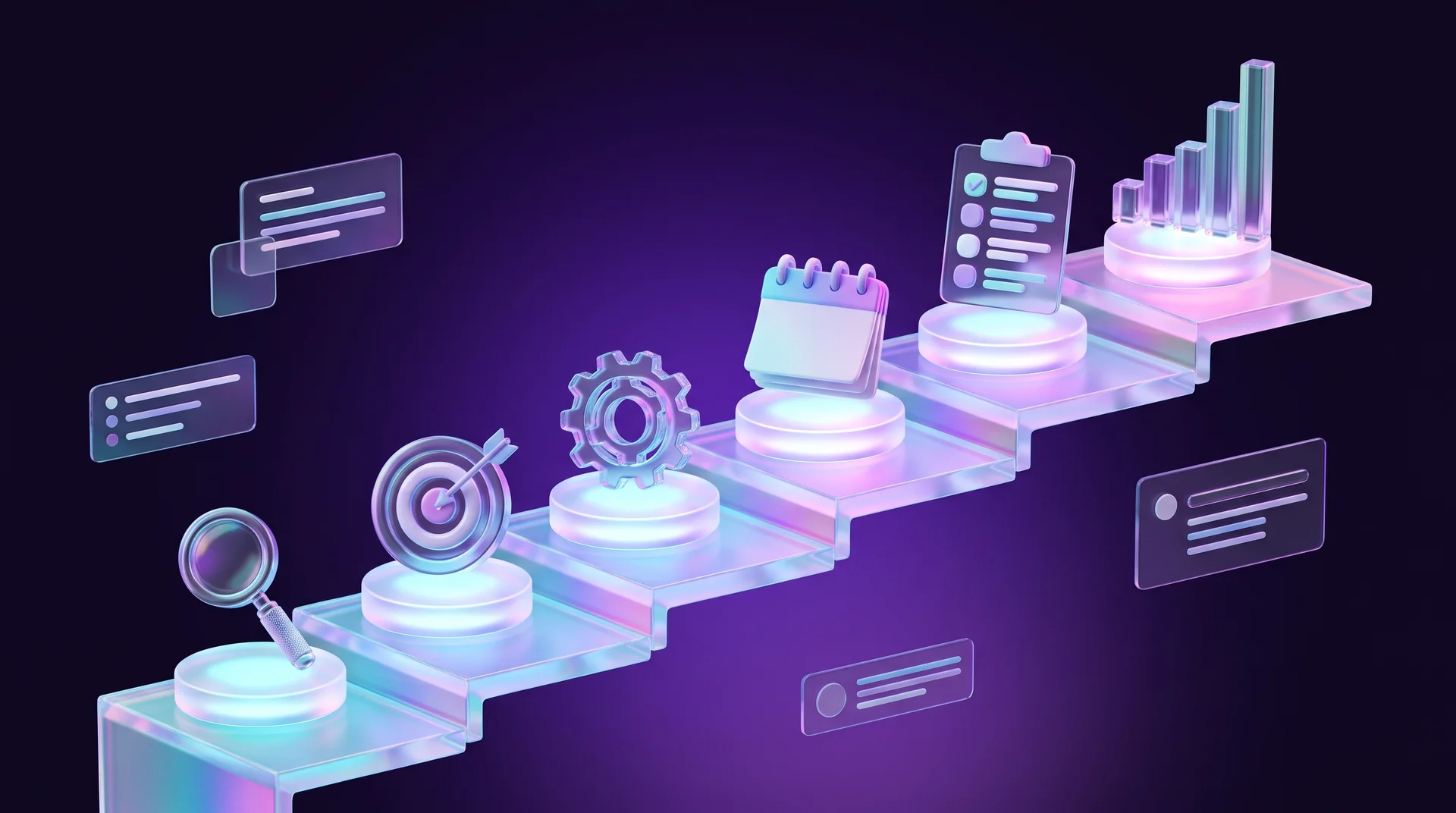
Building the marketing mix belongs to the practical planning stage of marketing. You start from your business goals and turn them into an action plan. There are six classic steps; let's go through them in order.
Step 1: Choose the elements of your mix
Pick the factors that have the biggest impact on your results. For example, the mix for a service business might include product, price, place, promotion, people, process, service policy and customer experience. The mix for an online store might include product, price, place, promotion and the checkout process on the website.
Step 2: Assess where you are today
Measure where each element stands right now: sales volume, price compared with competitors, number of leads from each channel, website conversion rate, response time to enquiries. This requires research into your customers, your competitors and the internal and external environment of the business. A handy tool for this stage is a SWOT analysis, while website and campaign data come from Google Analytics 4 and the ad platforms' own reporting.
Step 3: Set goals
Define a measurable goal for each element: which numbers you want to reach and by when. The goals must fit the overall strategy of the business. If the business goal is to improve profitability, there is no point setting promotion a goal of "as many leads as possible" at any cost.
Step 4: Choose your actions
For each element, choose the actions that will move it towards the goal. They span every area of marketing: product policy, communication, service and sales channels. For example: a new service package, an updated pricing page, a WhatsApp button on every page, a Google Search campaign.
Step 5: Break actions down into tasks
For every action, set a deadline, an owner and the resources needed, and choose the metrics you will use to judge the result. This gives you a tactical marketing plan: a complete working plan for promoting the product in the market rather than a list of ideas.
Step 6: Review the results and adjust
Check along the way and at the end of the period whether each element has reached its goal. If not, adjust the plan. In practice this is a cycle: a regular quarterly review of the mix beats an annual plan that nobody opens again.
Three principles of a marketing mix that works
To keep your mix effective, stick to three principles.
Consistency
Every element has to fit the others. A high-quality product needs high-quality service and high-quality advertising. If you sell a premium service, your website, photos, response time and even your invoices should all feel premium. Inconsistency is the most common reason a good campaign fails to produce sales.
Balance based on what the market cares about
You need to understand what your market is sensitive to. If customers choose on quality, your advertising should explain the benefits in detail. If they are price-sensitive, you need to show value for money and perhaps offer a basic package. Invest more in the element your customers actually weigh up.
Flexibility and regular updates
The elements of the mix can and should change with market conditions and with your results. A new competitor, rising advertising costs or a new channel your customers have moved to are all good reasons to reopen the plan.
Example: a marketing mix for a private clinic
To keep the model from staying theoretical, here is a made-up but typical example: a physiotherapy clinic in a mid-sized city that wants more private patients.
- Product: a course of treatment with a personal plan, short home-exercise videos and follow-up by WhatsApp between sessions.
- Price: a price per session and a discounted multi-session package, payment by card or mobile wallet, with VAT-inclusive prices shown on the website.
- Place: a website with online booking, a WhatsApp button on every page and an up-to-date Google Business Profile.
- Promotion: a Google Search campaign for local search terms, blog articles about back and knee pain, and patient reviews on the Google Business Profile.
- People: training for the reception team on fast, friendly replies, and therapist profiles on the website.
- Process: an automatic reminder before each appointment, a follow-up message after the session and a request for a review.
- Physical evidence: a clean, accessible clinic, a website whose design matches it, and clear booking confirmations.
Notice how each element supports the others: the campaign brings people to the website, the website makes booking easy, reminders reduce no-shows, and reviews strengthen the next campaign.
Common mistakes when building a marketing mix
Investing only in promotion
The most common mistake is increasing the ad budget when the real problem lies in the product, the price or the sales process. If visitors reach your website and do not get in touch, more budget will simply bring more visitors who do not get in touch.
Copying a competitor's mix
Your competitor may be targeting a different audience with a different cost structure. Learn from them, but make decisions based on your own data.
Ignoring the website as part of the mix
Your website is a product, a distribution channel and a promotion tool all at once. A site that is not mobile-friendly, loads slowly or fails to explain what customers get and at what price undermines all four elements.
Setting goals without measurement
"Raise awareness" is not a goal. Without metrics and tracking you cannot tell which actions work. Decide in advance what you will measure and where.
Building the mix once and forgetting it
Markets change, channels get more expensive, customers move to new platforms. A mix that has not been updated for a year no longer reflects reality.
How RJL Studio helps you put your marketing mix to work
At RJL Studio we work on the parts of the mix where your business meets customers online. We build websites and landing pages that present your product and pricing clearly, connect forms, WhatsApp and your CRM so that no lead gets lost, and run campaigns and social media marketing alongside SEO and content.
If you want to find out where your marketing mix is getting stuck – on the website, in the enquiry process or in your advertising – get in touch and we will set up a short call.
Frequently asked questions
What is the difference between the marketing mix and a marketing strategy?
A marketing strategy defines which audience you target, how the business positions itself and what the goals are. The marketing mix translates that strategy into practical decisions about product, price, place and promotion.
Is the 4P model still relevant?
Yes, as a foundation. Some consider it outdated because it does not cover service, customer experience or reputation. That is why many businesses use it as a starting point and add elements from the 7P model, or test their decisions through the 4C model.
Which model suits a service business?
Usually the 7Ps. In a service business, the people, the process and the environment in which customers meet the business influence the decision as much as the price does, so it is worth planning them explicitly.
How often should you update your marketing mix?
Review it once a quarter and whenever something significant changes: a new competitor, rising advertising costs, a product launch or a drop in your website's conversion rate.
Does a small business need a marketing mix?
Yes, even more than a large company. A small business has a limited budget, and the mix helps make sure the money does not go into advertising when the real problem is the website, the price or how customers are answered. A single page summarising your decisions for each element is enough to start.
Disclaimer: blog content is for general information and learning only and is accurate as of its publication date. It is not professional, legal, financial or business advice, nor a recommendation or call to take any action. Any use of this information is at the reader's own risk, and we accept no liability for any resulting loss. Links to external websites and tools are provided for convenience only. We recommend consulting a qualified professional before making decisions.